Guide · Radiators
Heat pump with radiators: how it works and when it makes sense
An air-to-water heat pump can heat the radiators you already have, but it works best when the water it sends to the system is lukewarm, between 35 and 55 °C. Traditional radiators are designed for water at around 70 °C: before deciding you need to check they are enough, or choose a high-temperature model or a hybrid system. The choice is made with a site visit and a calculation for your home.
30 minutes to gather the data Difficulty: Technician levelUpdated 25 October 2026
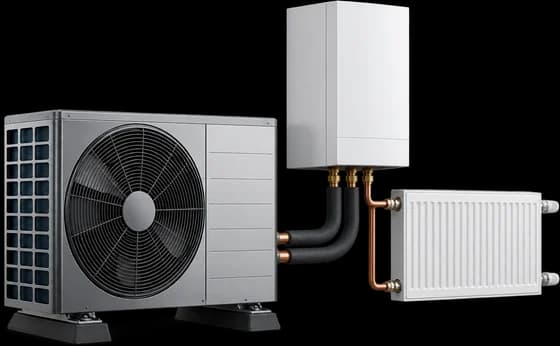
Do not open or move the outdoor unit yourself: it is heavy, it contains electrical parts and, in split models, a pressurised refrigerant gas circuit. Refills and work on the refrigerant circuit can only be done by F-gas certified staff, as DPR 146/2018 requires.
Step by step
Tap a step to mark it as done.
How an air-to-water heat pump works
It works like a refrigerator in reverse. A refrigerant gas absorbs heat from the outside air, even when it is cold outside. The compressor, which uses electricity, raises its temperature. Then the heat passes to the radiator water. The ratio between the heat produced and the electricity used is called COP and, according to Caleffi, ranges from about 1.5 to 5.
COP falls when it is colder outside and when the water has to leave hotter: that is why the flow temperature matters so much. On cold, damp days the outdoor unit stops now and then to melt frost, and this defrosting is part of normal operation.
There are two versions. In the monoblock, the refrigerant circuit stays entirely in the outdoor unit, connected to the home with water pipes. In the split, the outdoor unit and an indoor module are joined by refrigerant pipes, and the connection is made by F-gas certified staff.
With the radiators you already have
Traditional radiators are designed for water at around 70-75 °C, Daikin reminds us, while heat pumps give their best between 35 and 55 °C. Often, though, the radiators in a home are larger than needed, and with water at 50-55 °C they still heat the room, only more slowly.
Where they are not enough there are three routes, also described by Caleffi: add sections or a radiator in the coldest rooms, insulate the home better, or choose a high-temperature heat pump, for example with R290 gas, which reaches around 75 °C. The latter is the simplest solution to install, but the hotter the water, the more the machine uses.
Then there is the hybrid system: a condensing boiler and a heat pump that take turns depending on how cold it is outside. It is a middle way when radiators or space do not allow everything to be done with the heat pump.
Radiators and domestic hot water together
In general the heat pump does not have the power to heat shower water instantly, as a combi boiler does. That is why a cylinder is used: the water is stored hot, usually between 45 and 50 °C, and an electric heating element helps when a higher temperature is needed, for example in anti-legionella cycles.
The cylinder can be built into the indoor module or separate, and space must be planned for it. If there is no space at home, hot water production can be kept separate with a dedicated heat pump water heater.
How much it costs and which incentives apply
An air-to-water system replacing the boiler generally costs between 5,000 and 10,000 € installed, according to Ernesto's 2026 market estimates and the examples published on ProntoPro. A separate cylinder, electrical upgrades and radiators to be replaced push the bill up. These figures are indicative: the real price comes after the site visit.
How much you save on the bill depends on the electricity and gas prices you pay and how well the system is sized. With solar panels the numbers improve, especially if the machine runs during the sunny hours. The GSE's Conto Termico 3.0 includes replacing the boiler with heat pumps or hybrid systems among the incentivised works. Requirements, tax deductions and amounts change often: check them on the GSE and Agenzia delle Entrate websites, or with your accountant, before signing.
When to stop and call a technician
- The quotes do not state the machine's capacity or how it was calculated
- The system is a split and the installer does not show you their F-gas certification
- The meter's power must be increased or a line in the panel redone: the first is requested from the electricity supplier, the second is done by a company qualified for electrical systems
- The outdoor unit would go on the facade or in a shared area and the building manager has not approved it
- You already have a heat pump and the radiators stay lukewarm or error codes appear
Frequently asked questions
Does a heat pump work with old cast iron radiators?
Often yes, because old cast iron radiators are large and sometimes oversized. It must be checked room by room: where they are not enough, a few sections are added or a high-temperature model is chosen.
How does a heat pump work?
It takes heat from the outside air with a refrigerant gas and an electric compressor and passes it to the radiator water. For every kWh of electricity it returns more kWh of heat: how many depends on the outside cold and the water temperature.
How much does an air-to-water heat pump cost?
To replace the boiler in a home, market estimates run from about 5,000 to 10,000 € installed, and go higher with a separate cylinder, electrical work or new radiators. The real price comes from the site visit.
Can it do heating and domestic hot water together?
Yes, with a built-in or separate cylinder where the water is stored hot. It does not heat the water instantly like a combi boiler, so space for the tank must be planned.
Heat pump or hybrid system?
With suitable radiators, a well-insulated home and space for the outdoor unit, the heat pump on its own is the most direct choice. With small radiators or a home that loses a lot of heat, a hybrid with a condensing boiler may make more sense.
Who can install it?
A company qualified for heating systems under DM 37/2008, which issues the declaration of conformity at the end of the work. For split models the F-gas certification required by DPR 146/2018 is also needed. In Campania we can look at your home and the quotes with you on a video call before you decide.
Read also
Ready when you need us.
Book your visit by choosing a day and time. For emergencies we answer 24 hours a day, across Campania.