Guide · Leaks and taps
Burst pipe in the wall: who pays and what to do first
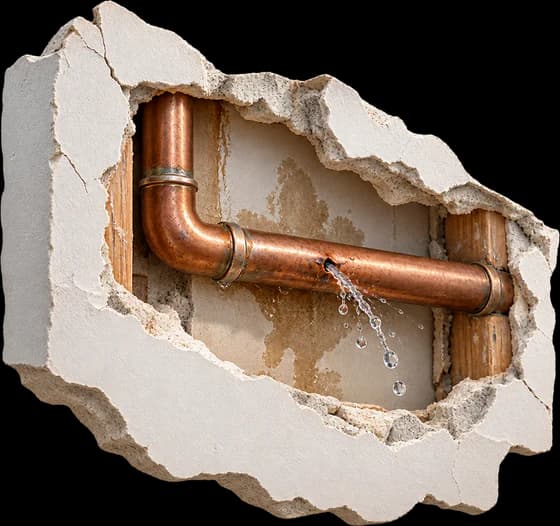
As a rule, whoever owns the broken section pays. The pipe that brings water only to your flat is yours. The riser that serves the whole building belongs to the condominium. For damage to a neighbour, insurance comes into play, yours or the building's. First of all, though, shut off the water, photograph the damage and notify the neighbour, the administrator and the insurer.
Difficulty: EasyUpdated 25 October 2026
If water is wetting sockets, light fittings or the fuse board, switch off the power only if you can reach the board while staying dry. Otherwise leave the room and call 112. Do not switch on a light fitting that is dripping water.
Step by step
Tap a step to mark it as done.
Your pipe or the building's: where the boundary lies
Article 1117 of the civil code treats the building's water and sewage systems as common property up to the point where they branch off towards the individual flats. The riser, the vertical pipe that brings water to all floors, and the drain stack therefore belong to the condominium. The section that leaves the riser and serves only your home is yours, even if it runs inside the wall or under the floor.
The Court of Cassation has clarified that the presumption of common ownership does not apply to the part of the system inside a single flat (ruling 27248 of 2018). The most debated case is the connection between your pipe and the stack, such as the branch fitting of the drains. Some rulings treat it as private (19045 of 2010) and others as common (778 of 2012).
When the break is right on the boundary, the condominium rules and a precise description of the spot matter. Before arguing about who pays, have a technician document where the break is and take that description to the administrator.
Damage to the neighbour and leaks from the flat above
For damage, article 2051 of the civil code applies: whoever has custody of the thing that causes the damage is liable, unless it was a fortuitous event. If the pipe in your flat breaks, damage to the neighbour is as a rule your responsibility. If the riser breaks, it is the condominium's. According to a recent Court of Cassation order (23012 of 2025), the failure of a system fitting is not a fortuitous event.
If water comes from the flat above, you first need to work out where it starts: a pipe or drain of the neighbour, the common riser, or a terrace. In the first case the neighbour above is liable, in the second the condominium. For leaks from a terrace or sun deck for exclusive use, the Joint Sections of the Court of Cassation (9449 of 2016) normally split the damage between the user, one third, and the condominium, two thirds.
If you rent, necessary repairs are normally the landlord's responsibility, except minor maintenance caused by use, which falls to the tenant (articles 1576 and 1609). A pipe built into the wall is usually in the first group. For an external flexible hose, which is changed without breaking anything, the Court of Cassation has asked for the tenant's responsibility to be assessed as well (24737 of 2007).
Water damage insurance: what to check
In a home policy, look for the right headings. Escaped-water damage covers water that comes out of the systems and damage to your own home. Third-party liability covers the damage you cause to neighbours. Tracing and repairing the fault, meaning finding the pipe and redoing walls and floors, is often a separate cover.
Many condominiums have a comprehensive building policy, which covers water damage starting from the building's systems. Some also include the pipes of individual flats, others only the common ones. The policy wording says which, and the administrator knows it. The claim usually goes through the administrator and the insurer sends a loss adjuster.
Also look at excesses, deductibles and exclusions: some policies do not reimburse demolition done only to find the break, or exclude frost and buried pipes. These are general indications. For your case, talk to the administrator and the insurer and, if you cannot agree, to a lawyer or a consumer association.
When to stop and call a technician
- The water does not stop even with the main stopcock of the house closed
- Water is running onto the neighbour or reaching light fittings, sockets or the fuse board
- The stain is growing and you do not know which pipe the water comes from
- The neighbour above does not answer and water keeps coming down from their flat: notify the administrator and, if there is a lot of water, call 115 or 112
- You, the neighbour and the administrator do not agree on where the break is
Frequently asked questions
Burst pipe in the wall: does the owner or the condominium pay?
It depends on which pipe broke. The section that serves only your flat is yours. The riser and other common parts belong to the condominium. On fittings at the boundary, judges do not always agree, so the exact spot matters.
Leak from the flat above: who pays?
Whoever has custody of the pipe or drain the water comes from: the neighbour if it is their system, the condominium if it is the riser. Have the source established and notify the neighbour and the administrator in writing.
Burst pipe under the floor: does it change anything?
The rule is the same: what matters is who the pipe serves. A pipe under your floor that brings water only to you is usually yours. For one that runs under the entrance hall or the courtyard, ask the administrator.
I rent: who pays for the burst pipe?
Normally the landlord, because a pipe in the wall is a system repair and not minor maintenance. Tell them in writing straight away and let the repairers in.
Does insurance pay for finding the fault too?
Only if the policy provides for it. It is often a separate cover, with its own limits and excesses. Check the policy documents and ask the insurer in writing which item applies.
Who finds the exact spot of the break?
A plumber who does leak detection. In Campania we can do it: we tell you precisely where the break is, which is the information the administrator and the insurer need.
Read also
Ready when you need us.
Book your visit by choosing a day and time. For emergencies we answer 24 hours a day, across Campania.