Guide · Radiators
How to bleed your radiators
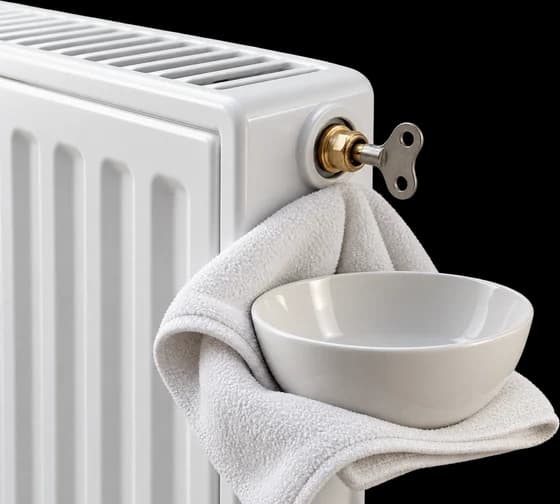
To bleed a radiator, turn the heating off, wait until the radiators are cold and put a cloth and a bowl under the small valve at the top. Open it slowly with the key: first air comes out with a hiss, then water, and at that point you close it. When you have done the round, check the boiler pressure and top it up if it has dropped.
5 minutes per radiator Difficulty: EasyUpdated 25 October 2026
Radiator water can come out very hot and dirty: work with the heating off and the radiators cold, and keep your face away from the valve. Bleeding is done only on the radiators. The gas boiler must not be opened.
What you need
- Radiator key or small flat screwdriver
- Bowl or glass
- Cloth or rag
Step by step
Tap a step to mark it as done.
Cast iron radiators and old bleed valves
On cast iron radiators the procedure is the same, as long as there is a bleed valve. You usually find it on the last section at the top, on the side opposite the water inlet. They hold more water and stay hot longer, so wait a little longer before opening.
On old radiators the valve may be encrusted or covered in paint. If it will not turn with the key, do not force it with pliers: Altroconsumo warns that you risk a leak that sometimes does not stop even when you close it again. In that case have the valve replaced.
If the radiator has no bleed valve
First look carefully at the top, on both sides. Sometimes there is an automatic valve that lets the air out by itself. Caleffi hygroscopic valves, for example, work automatically with the handwheel closed and open by about one turn only when the system is being filled.
If you find only a blind plug, do not unscrew it and do not loosen the pipe nuts. They are pressurised parts and are hard to close properly again. It is better to have a bleed valve fitted in place of the plug, so next time you can bleed it yourself.
With a thermostatic valve, before and after bleeding
While bleeding, keep the thermostatic valve fully open. In summer it is best to leave it on 5, as Caleffi advises, so the internal pin stays raised and does not stick closed in autumn.
If after bleeding the radiator stays completely cold even with the knob at maximum, the valve pin may be stuck. If instead it is cold at the bottom and hot at the top, air is not the problem: sludge has settled at the bottom and the system needs flushing.
As a rule, bleeding once a year before switching the heating on is enough, and again whenever you hear gurgling or find a radiator cold at the top. If air keeps coming back, something is letting it into the system and it is worth having it checked.
When to stop and call a technician
- The valve is stuck, covered in paint or turns without gripping
- Instead of a valve there is only a plug or a nut to loosen
- After bleeding the radiator stays cold at the bottom: there is probably sludge to flush out
- You have to bleed often and the boiler pressure drops in the following days
- Water leaks from the valve, the lockshield or the radiator body even with the bleed valve closed
Frequently asked questions
Do you bleed radiators with the boiler on or off?
Off, with the radiators cold. Altroconsumo explains that when the water is moving the air moves too and does not come out well at the valve, and with cold radiators you avoid scalds.
Which radiator do you start with?
In multi-storey homes, Buderus (a Bosch group brand) advises starting from the lowest floor and going up. On a single floor, Altroconsumo suggests starting from the radiator closest to the boiler. What matters most is doing the full round and checking the pressure at the end.
How do you bleed a radiator without a key?
Some valves have a slot and open with a small flat screwdriver, others have a handwheel to turn by hand. For those with the square you need the radiator key, which you can find at a hardware shop.
After bleeding, the boiler shows low pressure. Is that normal?
Yes, a little water comes out with the air. Bring the pressure back to the manual's value with the filling tap. If it drops again in the following days, there is a leak to find.
The radiator still gurgles after bleeding. Why?
Sometimes more air arrives from the rest of the system and a second round is needed after a few days of running. If the gurgling keeps coming back, perhaps together with falling pressure, something is letting air in and it is worth a check.
With central heating, can I bleed by myself?
Yes, you bleed the radiators in your home in the same way and you do not touch any boiler: the system pressure is looked after by whoever runs the boiler room. If you are in Campania and the radiators stay cold, we can also guide you on a video call.
Read also
Ready when you need us.
Book your visit by choosing a day and time. For emergencies we answer 24 hours a day, across Campania.