Guide · Water heater
Water heater anode and limescale: what they do and what to check
The anode is a metal rod, usually magnesium, that wears away inside an electric water heater instead of the tank and protects it from rust. Limescale, on the other hand, builds up on the heating element and the bottom, so the heater warms less and uses more power. You can operate the safety valve, set the temperature and watch for warning signs. The anode and the element are checked by the technician, at the intervals in the manual.
20 minutes Difficulty: EasyUpdated 25 October 2026
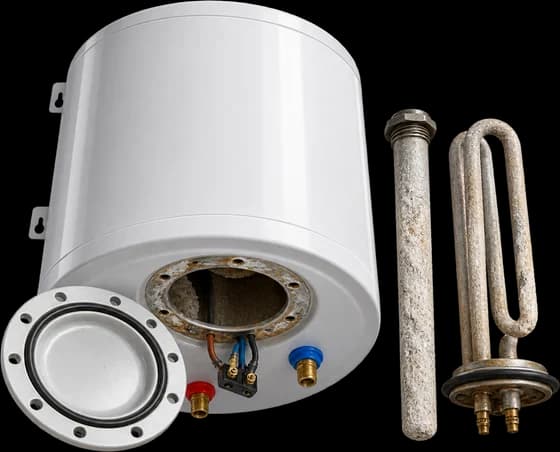
Before any check, switch off the power at the water heater's switch or at the fuse board. Do not open the cover at the bottom and do not take off the flange: the element connections are there and the water is under pressure. Water coming out of the safety valve can be very hot.
What you need
- Basin
- Torch
- White vinegar for the aerators
- Water heater manual
Step by step
Tap a step to mark it as done.
Water heater anode: what it does and how often it is changed
The tank of almost all electric water heaters is enamelled steel. The enamel can have tiny flaws, and where the metal is exposed the water starts to corrode it. A magnesium anode corrodes more easily than steel, so the corrosion attacks it and spares the tank. That is why it is called a sacrificial anode.
Over the years the anode gets shorter. How fast depends on the water and on use, and the interval is set by the manufacturer. The manual for the Ariston NUOS heat pump water heaters, for example, calls for replacement every two years. When the magnesium is used up, rust moves on to the tank, and once it is perforated the water heater has to be replaced.
There are also electronic anodes, called impressed-current anodes and often made of titanium, which protect the tank with a small current and do not wear away. Some models combine them with a magnesium anode, which still has to be checked, and some stainless steel tanks may have no anode at all. The data sheet for your model tells you which case you are in.
Limescale on the element: why the water heater heats less
When hard water is heated, limescale separates out and sticks to the hottest part, the heating element. The crust acts as insulation: the element has to work longer to heat the same water, it overheats and eventually fails.
Limescale that flakes off falls to the bottom and takes up space there. A water heater full of limescale heats fewer litres, bubbles and sometimes sends white flakes into the taps. If the element sheath breaks under the crust, water reaches the part carrying current and the trip switch cuts out.
The Ariston NUOS manual calls for descaling the element about every two years. With the very hard water in some areas of Campania, treat that interval as a maximum.
What the technician does and what it costs
The technician cuts the power, drains the water heater, opens the cover at the bottom and takes off the flange, the disc that holds the element and the anode. They remove the crust from the element, vacuum the limescale from the bottom, check how much of the anode is left and refit everything with a new gasket, as manufacturers recommend after every disassembly.
It is not worth doing it yourself: you are working on an electrical appliance and the gasket must hold under pressure. A badly refitted flange leaks, and the water ends up right on the element connections.
As an order of magnitude, Selectra gives 40 to 100 € for descaling and 25 to 50 € for the anode. If the element and thermostat are replaced as well, it rises to 180-220 €. These are indicative market figures: the real price depends on the model, the spare parts and how easy the water heater is to reach.
Water softener and filters: they help, in moderation
If the water at home is very hard, treating it before it enters the water heater reduces limescale on the element, valves and taps. You use a softener, which removes calcium and magnesium, or a dosing unit that adds an anti-scale product. Both are fitted on the cold water pipe and are plumbing jobs.
Softening too much is not good, though. The Ariston NUOS manual, for example, links the life of the water heater to the protection of the anode and does not allow water with a hardness below 12 °F. Whoever installs the softener sets it to an intermediate value.
When to stop and call a technician
- To check or change the anode, or to remove limescale from the element, the flange and element have to be taken off: this is a technician's job
- The trip switch cuts out when the water heater starts to heat
- Water comes out of the cover at the bottom or from the tank body
- When you open the safety valve no water comes out, or afterwards it never stops dripping
- Rust-coloured hot water comes out of the taps
Frequently asked questions
What does the water heater anode do?
It protects the tank from corrosion: it wears away instead of the tank. When it is used up, rust attacks the steel and eventually perforates it.
How often should the anode be changed?
The manual for your model says, and a lot depends on the water. For the Ariston NUOS, for example, it is every two years. The technician measures it when they open the water heater and changes it if it is worn.
Can I remove limescale from the water heater myself?
You can clean the aerators and the shower head and operate the safety valve. Cleaning the element means draining the appliance and taking off the flange, so you need the technician.
Does a water heater with a titanium anode need checking?
The electronic anode does not wear like a magnesium one, but limescale still forms on the element. Check in the manual whether there is also a magnesium anode and how often maintenance is due.
Do you service water heaters in Campania?
Yes, in Naples and the rest of Campania. We check the anode and the element, remove the limescale and tell you the price before we start. If you prefer, you can show us the water heater first on a video call.
Read also
Ready when you need us.
Book your visit by choosing a day and time. For emergencies we answer 24 hours a day, across Campania.